

Xinlei Yu (Leo)
My name is Xinlei (Leo) Yu, a second year CS PhD student at the University of Southern California, advised by Dr. Heather Culbertson. I’m also a Student Researcher at Google. I study how human experience can be represented and used to support robot reasoning and action.
My research asks how robots can use knowledge from people’s everyday experiences to interpret requests and act in the physical world. I develop systems and representations that connect first-person observations, spatial context, and human feedback. My recent work includes personalized robot manipulation from smart-glasses recordings and interactive 3D scene representations for haptic experiences.
Building on this work, I aim to develop structured, executable representations that people can inspect and refine, and that robots can use for reasoning and action. My broader goal is to enable robots to adapt to individual users and unfamiliar situations through experience and interaction.
I want to extend my heartfelt thanks to the many brilliant colleagues and mentors I’ve had the pleasure of working with. Their support and guidance—from insightful conversations that sparked new ideas, to their steady direction whenever I felt lost—have been instrumental in my journey, and for that, I am sincerely grateful.
I am open and happy to discuss new research projects, innovative ideas, and potential collaborations. Please feel free to contact me at xinleiyu@usc.edu
Publications
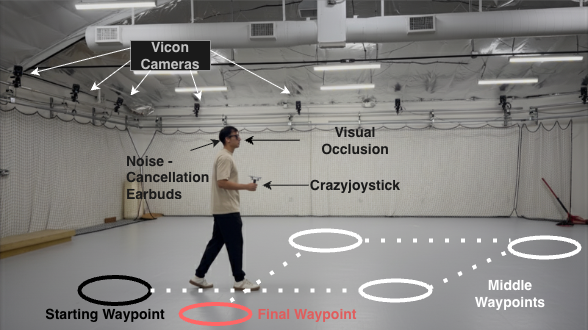
Propeller-based Handheld Forcefeedback Device for Navigation
IEEE Transactions on Haptics 2026
A handheld, propeller-based device that delivers force feedback for navigation.
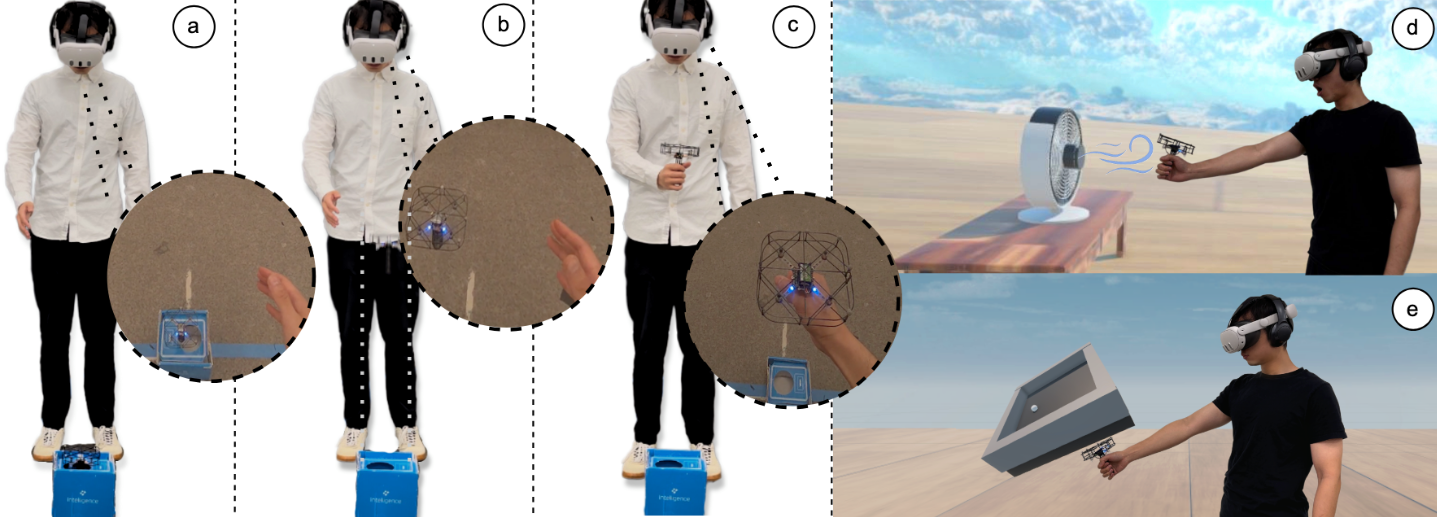
CrazyJoystick: A Handheld Flyable Joystick for Providing On-Demand Haptic Feedback in Virtual Reality
IEEE World Haptics Conference 2025
A flyable handheld joystick that brings on-demand haptic feedback into virtual reality.
Under Review
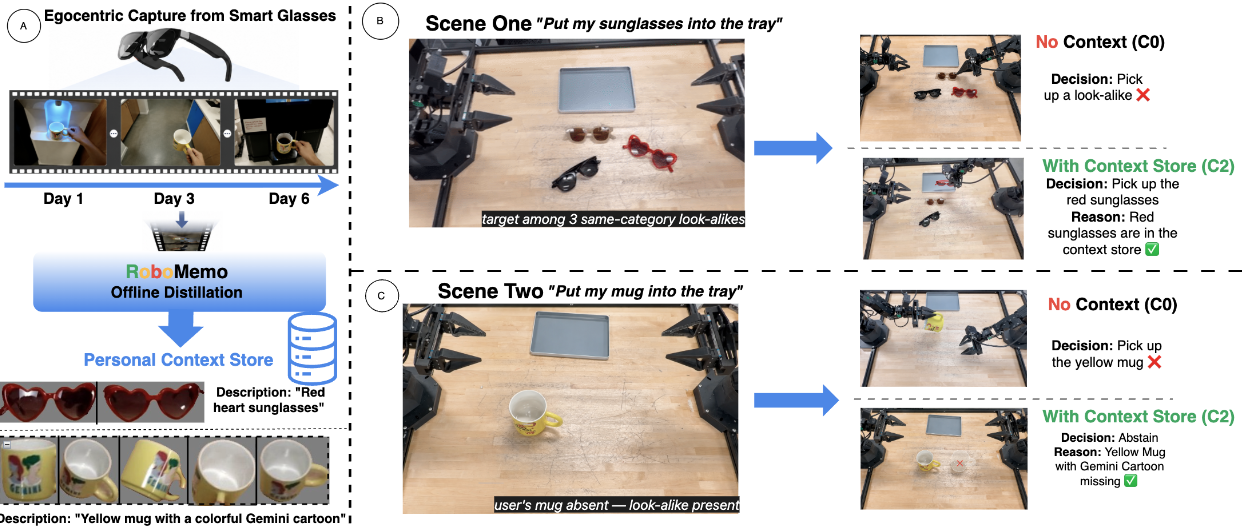
RoboMemo: Personalized Robot Manipulation from Everyday Smart-Glasses Recordings
Under reviewICRA 2027
Distills everyday smart-glasses recordings into object descriptions and visual references, helping robots identify a user's intended object—or decline when it is absent—without policy fine-tuning.
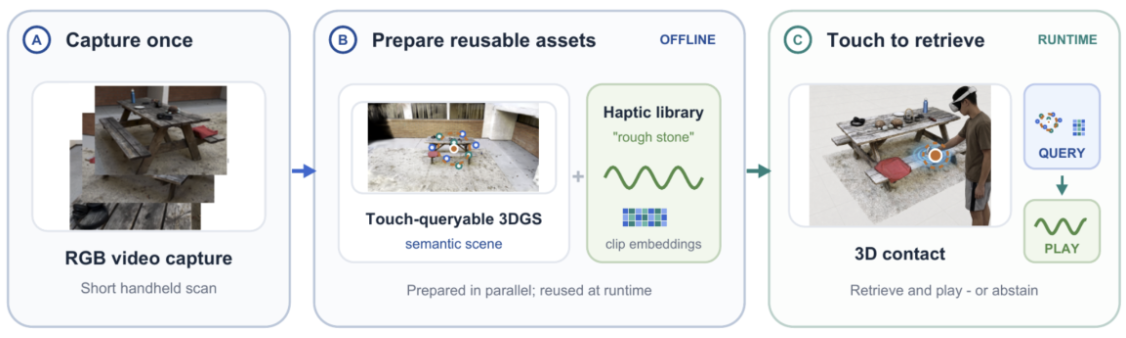
Cap2Hap: Contact-Conditioned Vibrotactile Retrieval for Captured 3D Gaussian Scenes
Under reviewIEEE VR 2027
Retrieves vibrotactile feedback from contact regions in reconstructed 3D Gaussian scenes, without meshes or material labels. Reports 7–11× fewer spurious within-surface haptic changes than screen-space baselines and higher perceptual ratings across three user studies.
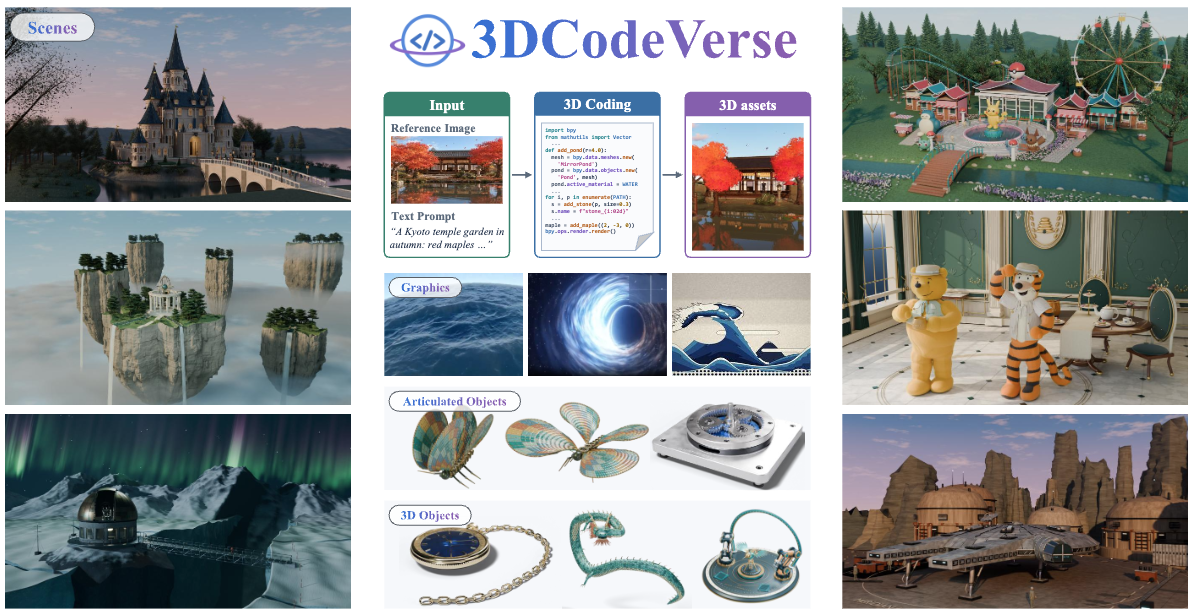
3DCodeVerse: 3D Generation via Code
Under reviewICLR 2027
Recasts 3D generation as executable code, combining a one-million-sample dataset, an automated multi-agent verification and curation pipeline, and fine-tuned open models for spatial reasoning and 3D creation.
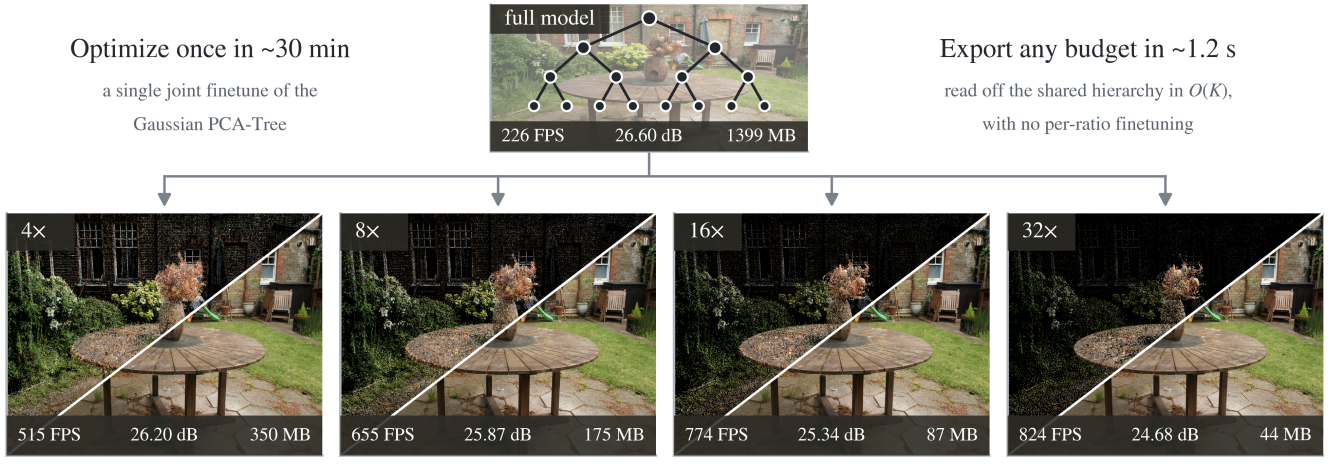
Gaussian PCA-Tree: Analytic Hierarchy for Multi-ratio 3DGS Compaction
Under review
Builds an analytic hierarchy for compressing trained 3D Gaussian scenes to different primitive budgets. Enables linear-time extraction without learned importance scores while preserving rendering quality under aggressive compression.
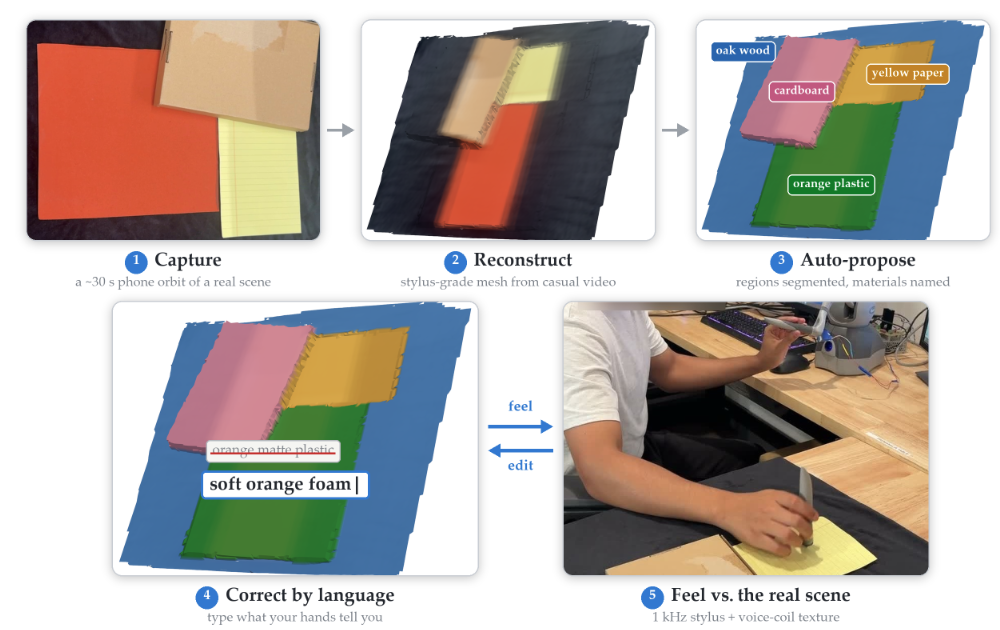
TouchTwin: Human–AI Haptic Authoring for 3D-Scanned Tabletop Scenes through Language and Touch
Under reviewCHI 2027
Turns phone scans into editable haptic scenes through a propose–feel–revise loop. In a 12-participant study, language and spatial edits improved realism from 4.0 to 5.6/7 and material-family accuracy from 52% to 92%.
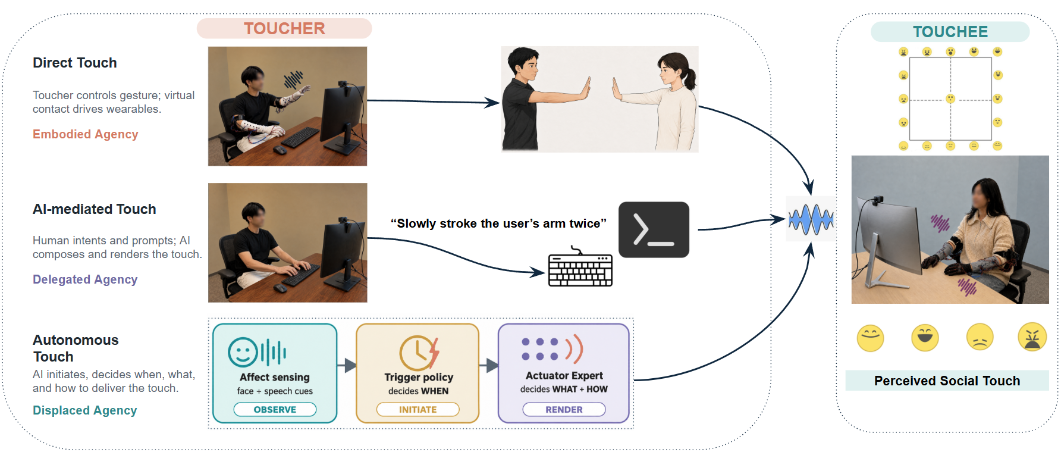
Shifting from Human Intent to AI Authorship across Three Loci of Agency in Mediated Social Touch
Under reviewCHI 2027
Examines directly enacted, AI-composed, and AI-authored touch in video calls. Two 24-participant studies distinguish AI's ability to preserve affective intent from the reduced social presence and naturalness associated with autonomous authoring.
Project Playground
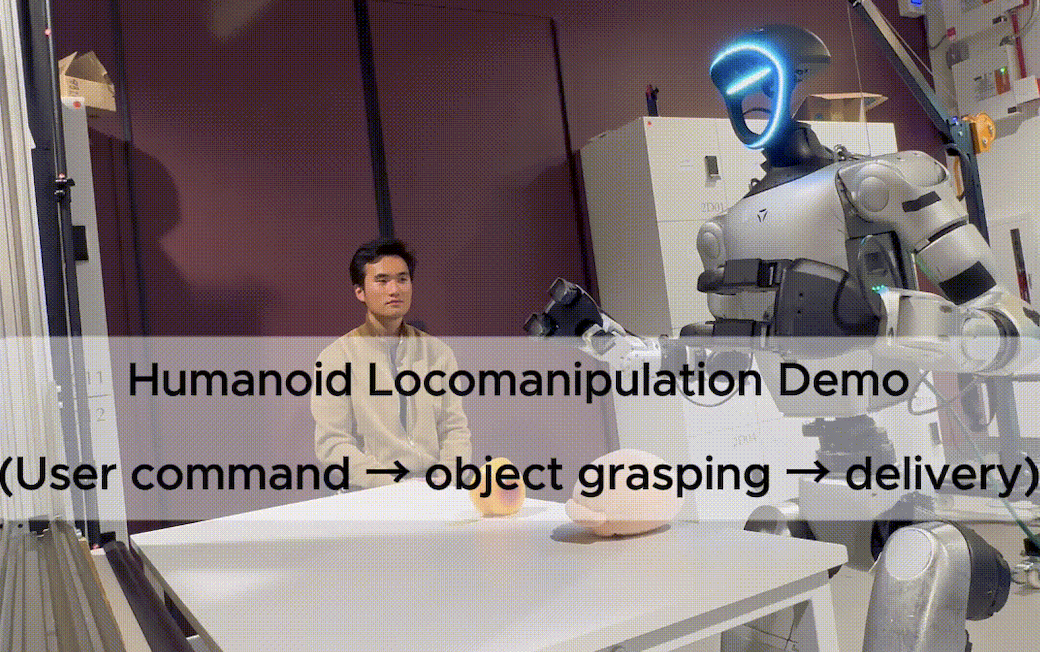 | Semantic 3D Perception and VLM-based Planning for Humanoid Loco-Manipulation [Demo Video Alternative] |
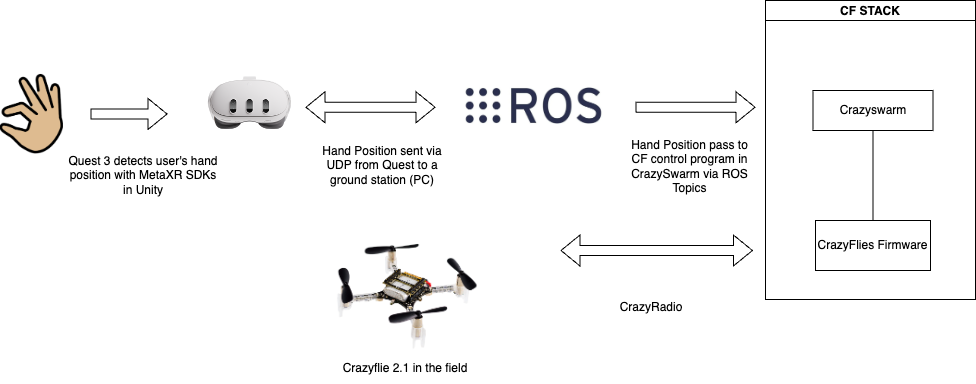 | Real-Time UAV Teleoperation via an Immersive VR Interface [Demo Video] [System Diagram] |
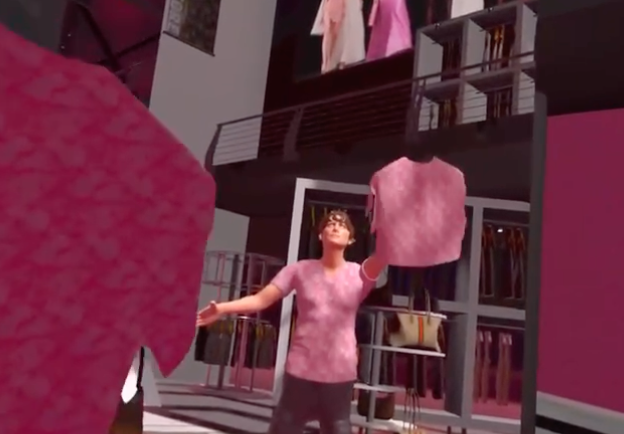 | VR Dressing Room [Demo Video] |
And More